

A common misconception is that an “exchange in wallet” works like a miniature version of Coinbase or another centralized trading platform. It usually does not. A wallet may show a token pair, calculate a quote, and let the user approve a transaction without leaving the app, but the actual conversion can depend on an outside liquidity provider, a decentralized protocol, or a separate blockchain mechanism. The interface is unified; the underlying trust model may not be.
That distinction matters especially for privacy-focused users. Someone holding Monero, Bitcoin, and other assets may value fewer accounts and less unnecessary disclosure, yet convenience can conceal new dependencies. The central question is not simply whether Cake Wallet can display an exchange button. It is: who sets the price, who controls the funds during execution, what information is exposed, and what happens if the route fails?
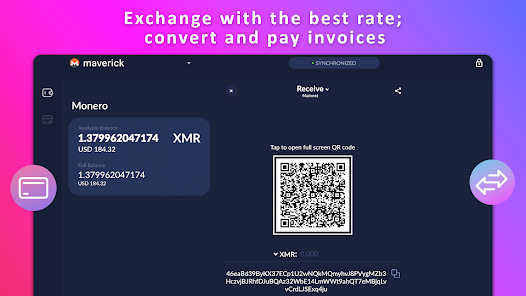
The useful mental model: interface versus settlement
In-wallet exchange separates two ideas that are often treated as one. The first is the interface: the screen where a user chooses an asset, enters an amount, reviews a quote, and approves a transaction. The second is settlement: the process by which one asset is sold and another is delivered. Settlement may be performed by a third-party exchange service, a market maker, a decentralized exchange contract, or a peer-to-peer mechanism.
In a typical routed transaction, the wallet requests a quote from a provider. The provider estimates the amount the user will receive, including its fee and often the network fee. The user then sends the source asset to an address or contract specified by the route. If the provider completes the trade, the destination asset is sent to the wallet. The wallet simplifies the workflow, but it cannot remove volatility, blockchain congestion, counterparty exposure, or the provider’s operational rules.
This is why a favorable-looking quote is not the same as a guaranteed exchange rate. The quote may expire after a short period. A network delay can make the received amount different from the initial estimate. On-chain fees may rise. A route may have minimum and maximum transaction sizes. Some services may also request identity information or block particular jurisdictions. In the United States, users should separately consider recordkeeping and tax consequences; an in-app swap can still be a taxable disposal or exchange depending on the facts and applicable rules.
Where Cake Wallet fits for privacy-conscious users
Cake Wallet is best understood as a multi-currency wallet experience that can place asset conversion beside ordinary wallet functions. That can be valuable for a Monero user who does not want to move funds to a centralized exchange merely to obtain another asset. The practical benefit is reduced operational friction: fewer address-book steps, fewer opportunities to paste the wrong address, and a clearer connection between the user’s balances and the transaction being authorized.
But “non-custodial wallet” and “private exchange” are not synonyms. If an outside provider handles the conversion, that provider may observe the source and destination details it needs to process the order. The blockchain may also reveal timing, amounts, or address relationships. Monero is designed to obscure important transaction relationships, while Bitcoin’s public ledger is substantially more transparent. Moving between them can therefore create an information boundary even when the wallet itself is designed with privacy in mind.
Users evaluating the application should obtain it from a source they can validate and should inspect the permissions, supported assets, quote provider, and current terms rather than relying on a general description. The cake wallet download resource may help someone begin that evaluation, but a download page alone cannot establish that a particular exchange route is private, solvent, available in the United States, or appropriate for a given transaction.
The sharper question is therefore not “Does the wallet protect privacy?” It is “Which part of the transaction is protected by the wallet, and which part is governed by another participant?” Seed phrase control may remain with the user while trade execution, compliance screening, pricing, and delivery depend on an external service. That division of responsibility is easy to miss because the entire process appears on one screen.
Why Haven Protocol requires separate reasoning
Haven Protocol belongs to a different conceptual category from a wallet interface. It has been associated with privacy-oriented digital money and synthetic assets, sometimes described as assets whose value is intended to track an external reference while using the protocol’s own monetary system. The attraction is understandable: users may want privacy-preserving exposure to different forms of value without repeatedly passing through a conventional exchange.
Yet a synthetic asset is not identical to the asset it references. Its usefulness depends on the protocol’s rules, collateral or issuance design, market liquidity, incentives, and the ability of the system to maintain the intended relationship. That introduces a distinct risk from ordinary wallet exchange. A user may face not only price movement and execution slippage, but also a design risk: the instrument may fail to track its reference reliably under stress.
Availability is another boundary condition. Support for a protocol, asset, or exchange route can change as software versions, liquidity, service providers, and network conditions change. There is no recent project-specific news supplied here that would justify claiming a newly launched Haven integration or a current change in its status. A careful user should verify live support inside the wallet and through the relevant project documentation before transferring funds. Search results, old screenshots, and community posts are not substitutes for a current transaction test with a small amount.
Haven also demonstrates why privacy and stability should not be collapsed into one label. A system can aim to conceal transaction relationships while still carrying liquidity risk. Conversely, a liquid market can be relatively easy to trade while exposing more information. Privacy, custody, settlement reliability, and price stability are separate properties. A wallet may improve one without guaranteeing the others.
Three alternatives and the trade-offs they reveal
Centralized exchange
A centralized exchange usually offers deeper liquidity, familiar order types, and a clearer customer-support process. For larger Bitcoin trades, that can mean less slippage and more predictable execution. The cost is account custody, identity verification in many cases, withdrawal controls, platform risk, and a detailed record of trading activity. It is often efficient, but it asks the user to trust an institution with both funds and personal information during part of the process.
Decentralized exchange or direct protocol route
A decentralized exchange can reduce reliance on a single custodian because settlement occurs through public blockchain rules or smart contracts. That does not make it automatically private or safe. Transaction histories may be permanently visible, smart-contract bugs can be consequential, and liquidity may be fragmented. A direct protocol route may also be unsuitable for Monero because Monero’s architecture differs from account-based smart-contract networks. The apparent absence of an intermediary can therefore be offset by technical complexity and irreversible mistakes.
In-wallet exchange
The wallet route emphasizes convenience and continuity. The user keeps the assets in a familiar application and may avoid opening a new account. This is particularly useful for modest, routine conversions where operational simplicity has real value. The sacrifice is often transparency about the full execution chain: the wallet may not be the market, the quote may be conditional, and the provider’s privacy practices may be less obvious than the interface suggests.
A reusable decision rule follows from this comparison. Use an in-wallet route when simplicity and control of the wallet are more important than advanced trading functionality, and when the provider’s terms are acceptable. Consider a centralized venue when liquidity, fiat access, or formal support dominates the decision. Consider a decentralized or protocol-native route only when the user understands the network, contract, privacy consequences, and failure modes. The “best” method is conditional, not universal.
How to evaluate an exchange before approving it
Begin with the quote, but do not stop there. Compare the amount sent with the amount received after every disclosed fee. Check whether the quote is fixed or merely estimated, whether the destination address can be changed, and whether the transaction has a refund process if the route expires. A low displayed fee can be misleading if the route has poor liquidity or a wide spread. The spread—the difference between the market price and the effective price offered—is frequently more important than the prominently displayed network fee.
Next, identify the information boundary. Ask which party receives an IP address, wallet address, transaction amount, or identity information. Privacy is not a binary switch; it is a flow of information. A user might accept a provider seeing a transaction while rejecting account-level behavioral profiling. That judgment depends on the amount, the asset, the jurisdiction, and the purpose of the transfer.
Operational security deserves equal attention. Confirm the recipient address on the device, not only in a copied message. Test an unfamiliar route with a small amount. Keep the recovery phrase offline, and never enter it into a website, support form, or “verification” screen. Be cautious with urgent prompts, fake wallet updates, and look-alike download pages. A technically private transaction can still be lost through phishing.
For US users, a further practical issue is documentation. Keep records of the date, assets disposed of, amounts, fees, and fair-value information available at the time. Privacy-oriented tools may reduce unnecessary exposure, but they do not eliminate legal obligations. When tax treatment or reporting is unclear, professional advice is more reliable than assumptions based on the wallet’s user interface.
What to watch next
The important future signal is not the appearance of another exchange button. It is whether wallet providers make the settlement path legible. Users would benefit from clearer disclosure of liquidity sources, quote expiry, privacy practices, jurisdictional restrictions, and failure handling. If those details become easier to inspect, in-wallet exchange could mature from a convenience feature into a more accountable financial tool.
For Haven Protocol and similar systems, the decisive question is whether privacy, liquidity, and stability can coexist under unfavorable market conditions rather than only during ordinary use. That is an open practical question, not a reason for either automatic dismissal or uncritical enthusiasm. A sensible user monitors current support, real liquidity, protocol changes, and the treatment of failed or delayed transactions.
Frequently asked questions
Is an exchange inside Cake Wallet automatically private?
No. The wallet may help users retain control of their keys, but an exchange provider can still receive information needed to quote and settle the transaction. The privacy result depends on the asset, route, provider, network metadata, and any identity or compliance process involved.
Is Haven Protocol the same as swapping Bitcoin for Monero?
No. A Bitcoin-to-Monero conversion exchanges two blockchain assets with different transaction models. Haven-related instruments may involve protocol-native or synthetic assets whose value depends on a separate system. They should be evaluated for tracking, liquidity, governance, and technical risk rather than treated as interchangeable with a direct asset swap.
What is the safest first step when trying an unfamiliar in-wallet exchange?
Verify current support and the provider’s terms, inspect the complete quote, confirm the destination address, and perform a small test transaction. The goal is not to eliminate every risk, which is impossible, but to limit the amount exposed while learning how the route actually settles.
Exchange in wallet is best viewed as a convenience layer over a more complicated settlement system. Cake Wallet can make that system easier to use, while Haven Protocol illustrates why privacy-oriented value transfer still involves questions about liquidity, design, and reliability. Once users separate interface, custody, privacy, and settlement in their mental model, the decision becomes less about slogans and more about choosing the trade-off they can explain and accept.